
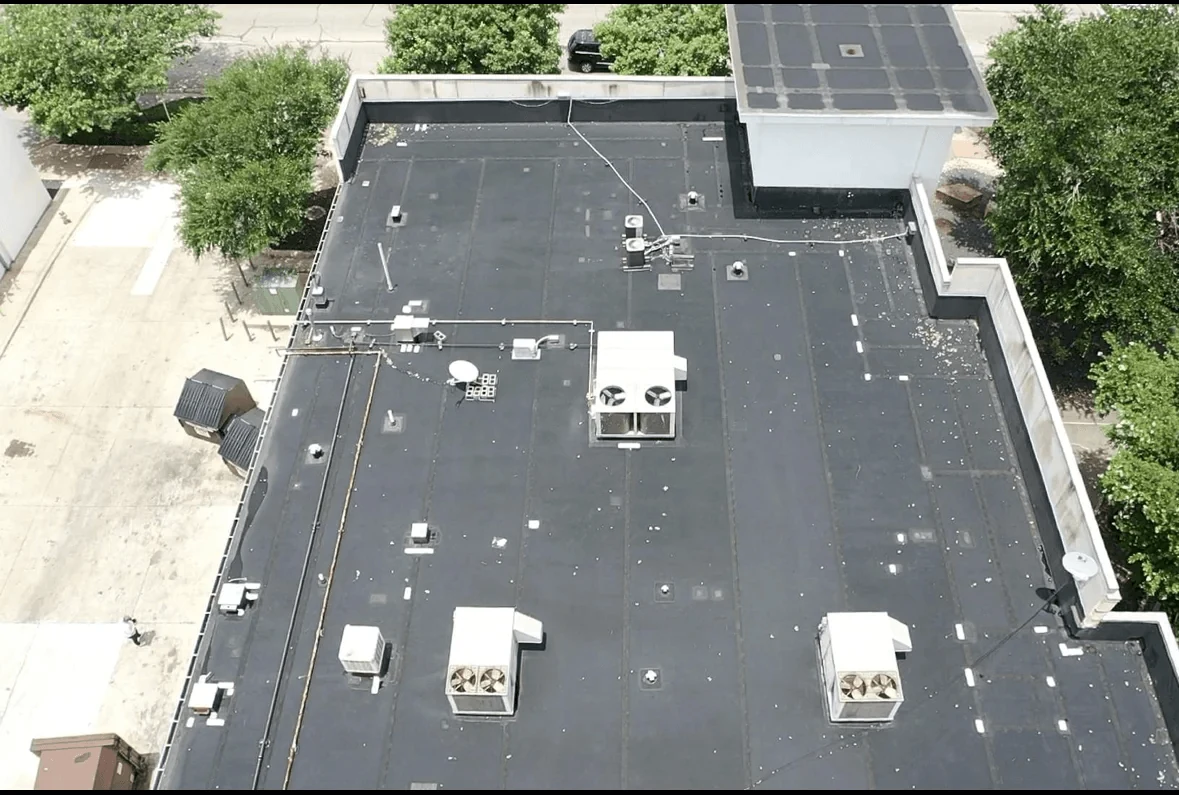
Black EPDM Rubber Membrane and Willamette Valley Weather
Black EPDM has been the standard low-slope rubber membrane for decades, and it still makes sense on plenty of Eugene roofs, particularly where a building has a simple field with few penetrations and an owner values a track record over the newest membrane chemistry. The tradeoff against TPO and PVC is seam method: EPDM relies on taped or liquid-applied seams rather than heat welds.
Taped Seams Under Nine Months of Rain
EPDM seams are bonded with seam tape or liquid adhesive rather than fused by heat, which means the bond depends on surface prep and cure conditions at the time of installation. On a job site where rain can move in with a few hours' notice off the Pacific, we watch forecasts closely and won't run seams on a day where moisture is likely to compromise the bond before it cures.
Once installed and cured, a well-prepped EPDM seam holds up fine through a normal Willamette Valley winter. The failure mode we see on older EPDM roofs isn't the membrane field, it's seams that were taped in marginal weather years ago and have slowly opened at the edges from repeated wet-dry cycling.
Dark Surface, Heat Load, and Building Type
Black EPDM absorbs more solar heat than white membrane, which is less of a concern here than it would be in a hotter climate, but it still matters for rooftop unit efficiency and membrane thermal cycling. On buildings where cooling load isn't a major cost driver; cold-storage-adjacent warehouses and lightly conditioned manufacturing space around the west Eugene industrial area; the color tradeoff is minor.
Where a building has significant HVAC load or a flat roof serving as unconditioned attic space above office areas, we'll bring up white EPDM or a reflective membrane as an alternative before defaulting to black on cost alone.
Ponding, Moss, and the Rubber Surface
EPDM's smooth rubber surface sheds surface debris reasonably well, but ponding water sitting against a taped seam for extended periods is the specific failure mode we watch for on this membrane more than any other. Standing water finds the edge of a seam faster than it degrades the field membrane itself.
Moss and algae growth on EPDM tends to concentrate in low spots and around drains and curbs rather than across the whole field, which is actually useful diagnostically; heavy moss at a specific spot on an EPDM roof usually means that spot holds water longer than it should rather than simply being shaded.
- Seams bonded with tape or liquid adhesive, not heat-welded
- Smooth rubber surface sheds general debris well
- Stays flexible in cold temperatures better than thermoplastic membranes
- Ponding at seam edges is the primary long-term failure mode
- Dark surface absorbs more heat, a minor factor in this climate
- Best suited to simple roof fields with fewer penetrations
Drainage Detailing on EPDM Roofs
Because EPDM doesn't tolerate long-term ponding at seams as well as a welded membrane, we're more conservative about drain spacing and tapered insulation on EPDM specs than we are on TPO or PVC jobs. On older Eugene commercial buildings being recovered rather than torn off, that sometimes means adding a drain or two the original design didn't include.
We also flag internal drains with a documented history of slow flow, common on buildings from the 1970s and 80s that make up a lot of the region's commercial stock, since a partially clogged internal drain concentrates standing water exactly where EPDM seams are most vulnerable.
Cold Weather and Ice-Storm Exposure
EPDM rubber stays more flexible in cold temperatures than TPO or PVC, which is one of its real advantages during the Valley's occasional hard freezes and ice events. A rubber membrane is less likely to crack from impact or foot traffic during a cold snap than a stiffened thermoplastic sheet.
That flexibility doesn't extend to the seam tape, though, which can lose tack in extended cold. We avoid seam repairs during active cold snaps when the schedule allows and prioritize pre-winter inspection instead.
Maintenance Expectations Over the Roof's Life
An EPDM roof isn't maintenance-free just because the membrane itself is durable. Seam inspections, drain clearing, and moss removal need to happen on a schedule, and we build that schedule around the Willamette Valley's wet season rather than a generic calendar interval. Fall, before the heaviest rain arrives, is when we push hardest to get eyes on the roof.
Owners who skip a few years of inspection on an EPDM roof usually end up with a seam issue that could have been caught early, since taped seams degrade gradually rather than failing all at once. Catching that early is cheaper than a full seam replacement later.
Questions on Black EPDM for Local Commercial Roofs
Is EPDM still a good choice for a Eugene commercial roof?
Yes, particularly on simpler roof fields with a track record of good drainage. We weigh it against TPO and PVC based on the roof's penetration count and drainage history, not by default.
Why do EPDM roofs leak at seams more than the field membrane?
Taped and liquid-applied seams depend on surface prep and cure conditions at installation. Once cured they hold well, but they're more sensitive to standing water over years than a heat-welded seam.
Does black EPDM cause higher cooling costs here?
It's a smaller factor in the Willamette Valley than in hotter climates, but on heavily conditioned buildings we'll discuss reflective alternatives before defaulting to black.
How does EPDM handle ice storms compared to TPO?
The rubber field stays more flexible in cold and resists cracking from impact better. Seam tape can lose tack in extended cold, so we avoid non-emergency seam repairs during active freezes.
Where does moss show up first on an EPDM roof?
Usually in low spots and around drains rather than across the whole field, which often signals a drainage issue at that specific location rather than just shading.