
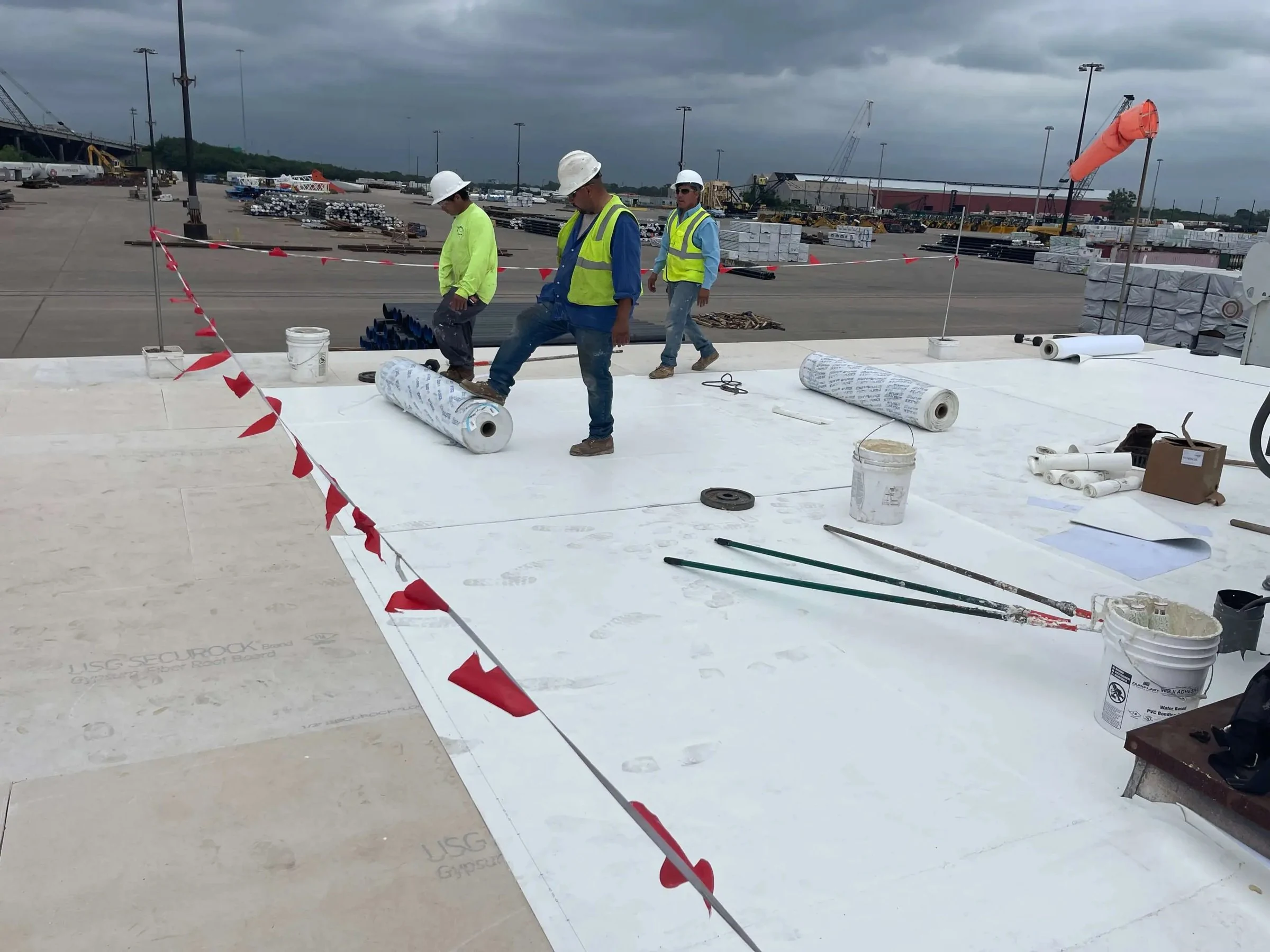
PVC Membrane for Grease and Chemical Exposure on Eugene Roofs
Most low-slope roofs in this market don't need PVC's chemical resistance. The ones that do tend to know it already: kitchen exhaust zones on standalone restaurant buildings, manufacturing sites running solvent or process exhaust, and industrial buildings where rooftop equipment vents something the membrane has to tolerate day after day.
Why Chemical Resistance Changes the Membrane Choice
Grease-laden exhaust from a commercial kitchen degrades TPO and EPDM over time, softening the membrane surface and shortening its service life around the exhaust fan footprint. PVC's chemical composition resists that kind of breakdown far better, which is why we recommend it specifically for restaurant roofs and any building with rooftop equipment discharging oils, solvents, or process byproducts.
This matters more in a market where the roof is already fighting sustained moisture. A membrane that's chemically compromised at the exhaust zone and also sitting under near-constant rain has two failure mechanisms working on it at once, and that combination shortens service life faster than either problem alone.
Heat-Welded Seams for the Same Reason TPO Uses Them
Like TPO, PVC seams are heat-welded rather than taped or adhered, which gives the same durability advantage in a climate that rarely offers a long dry window for adhesive-based seams to cure properly. We test every weld with a probe at installation and follow up on service visits, with particular attention to seams near exhaust stacks and equipment curbs where the membrane sees the heaviest chemical exposure.
PVC membrane also tends to hold up well against foot traffic near rooftop mechanical units, which is relevant on manufacturing buildings where staff access equipment regularly for maintenance and the roof surface sees more wear than a typical warehouse field.
Where We're Installing PVC Around the Valley
Standalone restaurant pads along commercial corridors are a common PVC application, since kitchen exhaust is a near-universal condition on those buildings regardless of cuisine or size. We also see PVC on manufacturing buildings tied to the area's wood-products and light industrial base, where roof-mounted dust collection or process exhaust systems put chemical stress on the membrane that a standard TPO roof wasn't built to handle.
Institutional buildings occasionally call for PVC too, particularly kitchen and laundry service areas on larger healthcare-adjacent facilities where exhaust volume and grease content run higher than a typical office building roof would see.
Cost Versus the Alternative
PVC runs higher in material cost than TPO or EPDM, and that's a fair question building owners raise. The comparison that matters isn't PVC against TPO in the abstract, it's the cost of PVC against the cost of replacing a TPO roof early because grease exposure degraded it faster than expected. On a building with confirmed chemical or grease exposure, PVC's upfront cost is usually the cheaper path over the roof's full service life.
We don't recommend PVC on buildings without that specific exposure. A standard warehouse or retail roof with clean HVAC penetrations doesn't need PVC's chemical resistance and does fine on TPO at a lower installed cost.
What We Check on a PVC Roof
- Weld integrity at seams near exhaust stacks and equipment curbs
- Grease buildup and surface condition around kitchen exhaust zones
- Drain and scupper clearing before wet season
- Flashing at parapets and rooftop equipment penetrations
- Membrane wear at high-traffic maintenance access paths
- Moss and debris accumulation at shaded roof edges
Grease Trap and Exhaust Maintenance Matters Too
A PVC membrane resists chemical exposure well, but it isn't a substitute for proper grease trap maintenance on the exhaust system itself. We coordinate with building management when we see exhaust fans discharging directly onto the membrane without adequate grease containment, since that's a mechanical issue as much as a roofing one, and fixing the discharge point extends the roof's life regardless of membrane type. Rooftop grease pans and filter screens need their own cleaning schedule, and when that schedule slips, the membrane underneath the exhaust footprint takes the brunt of it long before anyone notices a change in kitchen operations. We flag that gap to property managers rather than treating it as outside our scope, since it directly affects how long a PVC installation actually lasts.
On manufacturing sites with process exhaust rather than kitchen grease, the same logic applies to filter and scrubber maintenance upstream of the roof penetration. A well-maintained exhaust system and a chemically resistant membrane work together, and neglecting one undercuts the value of investing in the other.
Common PVC Questions
How do I know if my building actually needs PVC instead of TPO?
If there's a kitchen exhaust fan, solvent-based process exhaust, or any rooftop equipment discharging oils or chemicals onto the membrane, PVC is worth the upfront cost. Without that exposure, TPO is usually the more economical choice.
Does PVC hold up as well as TPO against the constant rain here?
Yes, the heat-welded seam performs the same way structurally as TPO's welded seams. PVC's advantage over TPO is chemical resistance, not moisture performance, since both handle sustained rain well when properly installed and drained.
Can PVC be installed over an existing membrane?
Sometimes, depending on the condition and moisture content of the existing roof assembly. We run a moisture survey before recommending a recover approach over tear-off.
How often should a PVC roof near a kitchen exhaust be inspected?
More frequently than a standard low-slope roof, given the added grease exposure. We typically recommend service visits on a tighter interval for restaurant roofs than for a clean warehouse field.
Is PVC more prone to any specific issue in this climate?
Not particularly. Its main limitation is upfront cost, not performance. Once installed and welded correctly, PVC handles the valley's wet season as well as any heat-welded single-ply membrane.