
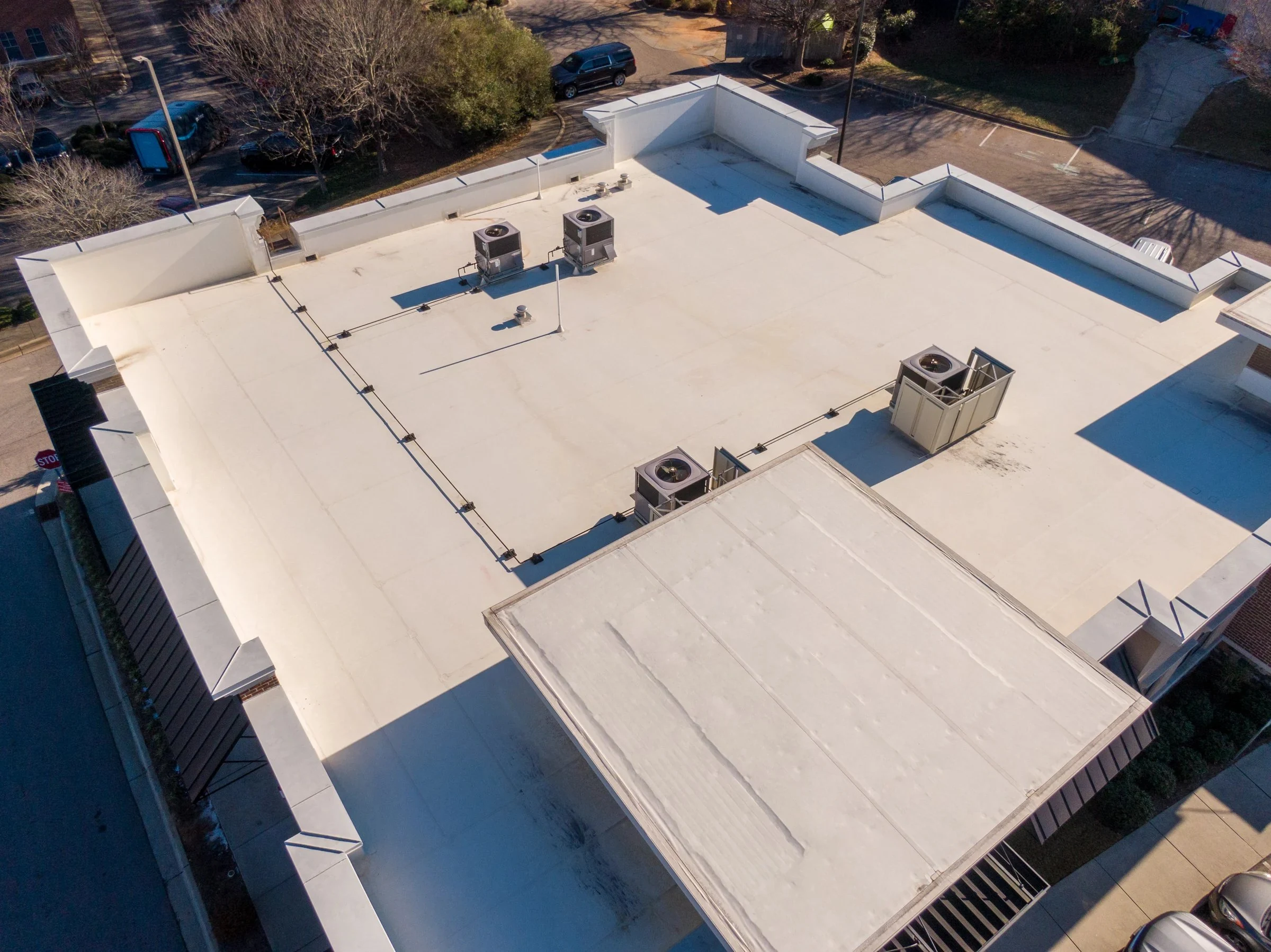
60-Mil TPO Membrane for Willamette Valley Roofs
Sixty-mil TPO is the baseline thickness we spec on low-slope commercial roofs across Eugene and Springfield when a building needs a reflective, heat-welded system without paying for the extra membrane thickness of an 80-mil sheet. It holds up fine on most warehouse, retail, and office roofs where foot traffic is limited to service techs and the roof isn't fighting standing water year-round.
Why Thickness Matters When It Rains Nine Months a Year
A 60-mil sheet gives you enough material to survive normal foot traffic, hail, and the freeze-thaw cycling we get most winters without turning brittle at the seams. The tradeoff against 80-mil is thinner reinforcement scrim, which matters most on roofs with rooftop units, frequent maintenance walk paths, or standing debris from fir needles and bigleaf maple leaves that mat down and hold moisture against the membrane.
Because TPO seams are hot-air welded rather than taped or glued like EPDM, they form a continuous plastic weld rather than an adhesive bond. That matters here because Eugene roofs sit wet more days than not between October and May, and a welded seam doesn't rely on adhesive strength that can weaken under sustained moisture. We still run seam probes after installation and again during the first wet season to confirm the weld held under real rain load rather than a dry-day inspection alone.
Ponding and Drainage on Low-Slope TPO Roofs
TPO tolerates occasional ponding better than built-up asphalt roofing, but 60-mil sheet isn't a substitute for correct slope. On flat commercial roofs around the Gateway area and west Eugene's industrial parks, we look hard at drain placement and tapered insulation before we ever talk membrane thickness, because a well-drained 60-mil roof will outlast a poorly drained 80-mil roof every time.
Where a roof has a known low spot; usually near a parapet wall or an old HVAC curb that was never properly flashed; we'll recommend either additional drainage or a crickets-and-tapered-insulation fix before covering it with new TPO. Covering a ponding condition with new membrane just moves the problem down the road, and it's the kind of shortcut that shows up as a warranty claim two winters later.
- Heat-welded seams instead of taped or glued laps
- Reflective surface reduces summer rooftop unit load
- Adequate thickness for standard foot traffic and hail
- Lower material cost than 80-mil for budget-driven recovers
- Requires correct slope and drainage, not a ponding fix on its own
- Smooth surface sheds moss more easily than granulated cap sheet
Moss and Organic Growth on Reflective Membranes
White and light-gray TPO sheds moss less aggressively than granulated modified bitumen because the surface is smooth rather than textured, but it isn't immune. Roofs shaded by mature Douglas fir or oak canopy; common on properties near the University of Oregon and older commercial blocks along Willamette Street; collect enough organic debris in valleys and around curbs that moss and algae take hold within a couple of wet seasons if nobody's cleaning drains.
We tell owners the same thing every time: a TPO roof that gets swept and drain-cleared twice a year, once before the fall rains start and once after the leaves are down, will outperform an identical roof left alone. Moss holds moisture against the seams longer than the membrane surface itself would otherwise stay wet, and that's where premature seam stress shows up first.
Cold Snaps and Occasional Ice
TPO handles the Willamette Valley's mild winters well, but the region gets an ice storm most years, sometimes with sustained freezes below 20 degrees. Thermoplastic membranes stiffen in hard cold, and a crew walking a roof during or right after an ice event can crack a membrane that's fine in normal conditions. We push maintenance and inspection visits to before the cold snap rather than during it whenever the schedule allows.
Ice accumulation at parapet walls and around rooftop equipment also concentrates weight and meltwater exactly where seams and flashings are most vulnerable. On buildings that see this every year; older warehouse stock in Springfield's industrial corridor especially; we watch those transition details closely during fall inspections rather than waiting for a leak to show up in January.
When 60-Mil Is the Right Call
Sixty-mil TPO makes sense on roofs with light rooftop traffic, adequate existing drainage, and a 15- to 20-year ownership horizon rather than a 30-year hold. It's also the more budget-conscious option for owners doing a recover over existing insulation where the structural deck doesn't need full replacement.
We walk owners through the tradeoff against 80-mil directly rather than defaulting to whichever sheet carries a better margin. If a roof has heavy mechanical traffic or a documented ponding history, we'll say so and recommend the thicker sheet before the contract is signed.
What Eugene Building Owners Ask About 60-Mil TPO
Does 60-mil TPO handle standing water on a flat roof?
It resists short-duration ponding better than asphalt built-up roofing, but persistent standing water from a low spot or clogged drain will still shorten the membrane's life regardless of thickness. We address the drainage condition first.
How often should drains be cleared on a TPO roof here?
At minimum twice a year; before the fall rains start and again once deciduous leaves are down; and more often on roofs under heavy tree canopy near campus or older residential-adjacent commercial blocks.
Will hot-air welded seams hold up in constant rain?
Yes, a properly welded seam is a continuous plastic bond rather than an adhesive that can be undermined by sustained moisture. We verify welds with seam probes during installation and again in the first wet season.
Is 60-mil TPO a good fit for a roof recover over existing insulation?
Often yes, provided the existing insulation is dry and the deck doesn't need structural work. We inspect the substrate before recommending a recover instead of a full tear-off.
Does an ice storm damage TPO membrane?
Direct impact or foot traffic during a hard freeze can crack a stiffened membrane. We schedule inspections and any needed repairs before cold snaps rather than during them when possible.