
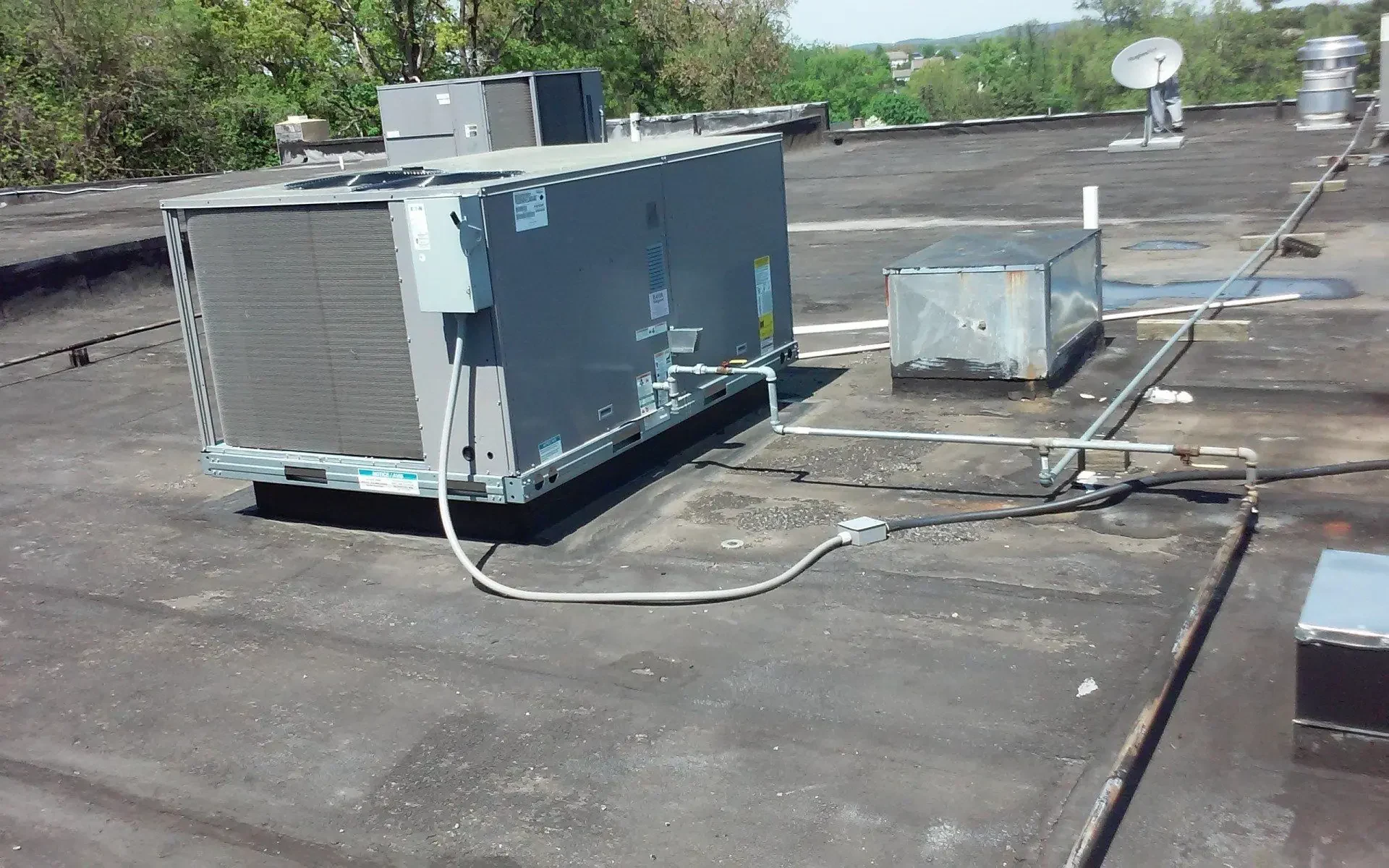
TPO Membrane Performance on Eugene's Low-Slope Roofs
TPO has become the default membrane for new low-slope commercial roofs in this market, and for a straightforward reason: heat-welded seams hold up better under sustained rain than adhered or mechanically fastened laps that rely on sealant alone. On a roof that sees moisture nine months a year, seam integrity is most of the battle.
Why Seam Welding Matters More Here Than Elsewhere
A TPO seam is heat-fused into a single homogenous sheet rather than glued or taped, which means there's no adhesive layer to break down under repeated wet-dry cycling. In a drier climate that distinction matters less, because the membrane gets long stretches to fully cure and dry between rain events. In Eugene, a roof can go weeks without a real drying window between October and May, so any seam that depends on adhesive bond strength is working under worse conditions than it would in most of the country.
We test welds with a probe on every installation and every service call, checking pressure points around penetrations and T-joints where three sheets meet, since that's where a marginal weld shows up first.
Reflectivity, Moss, and What White Membrane Actually Shows You
TPO's white or light-gray surface reflects summer heat, which is a modest benefit in a market with mild summers, but the bigger practical upside is diagnostic: algae streaking and moss colonies show up clearly against a white field, long before they'd be visible on a dark membrane. That visibility helps us catch a developing moss patch near a drain or low spot before it's holding water against the seam.
Moss does grow on TPO here, particularly in shaded areas near tree lines or on north-facing parapet walls where the membrane stays damp longest. It doesn't damage the membrane directly, but a thick mat holds water against the surface and can mask a slow leak underneath, so we clean growth back during service visits rather than letting it accumulate.
Where We Install and Repair TPO Around the Valley
Steel-deck distribution and warehouse buildings on the west side of Eugene are frequent TPO candidates, especially newer construction where the roof has a clean field and standard penetration count. Institutional buildings near the university, with their layered additions and dense mechanical curb clusters, also do well with TPO because heat-welded detail work around irregular penetrations is more reliable than field-fabricated flashing on older membrane types.
We also see a fair amount of TPO recover work on buildings originally built with EPDM or older single-ply that's reached the end of its service life. If the deck and insulation test dry, a TPO recover over a stripped-down substrate is often the more economical path than full tear-off.
What Shortens a TPO Roof's Life in This Climate
Clogged drains are the single biggest threat to a TPO roof here. Standing water that sits for days at a time accelerates plasticizer loss at the membrane surface and stresses seams at the low point first. Fastener backout on mechanically attached systems is the second issue we see, usually from thermal movement combined with wind uplift during winter storm systems moving through the valley.
Punctures from foot traffic near rooftop units are common on buildings with frequent HVAC service, and on manufacturing sites with rooftop process equipment, we watch for chemical exposure at exhaust stacks, since TPO isn't the most chemical-resistant membrane option if the building runs solvent-heavy processes.
What a TPO Service Visit Covers
- Probe testing of field seams and T-joints
- Drain and scupper clearing before and after the wet season starts
- Moss and algae removal from shaded and low-slope areas
- Flashing inspection at parapets, curbs, and penetrations
- Fastener check on mechanically attached systems
- Membrane thickness and wear check at high-traffic zones
Deciding Between TPO and Other Membrane Options
TPO isn't automatically the right call for every low-slope building. Buildings with heavy grease or chemical exposure, like restaurant kitchen exhaust zones, often do better with PVC. Buildings needing a ballasted, low-maintenance surface with a long installation track record sometimes stay with EPDM. We walk the roof and look at deck type, penetration density, and what the building actually produces or handles before recommending TPO over the alternatives.
Cost is usually competitive with EPDM and lower than PVC, which is part of why it's become the common choice for straightforward warehouse and retail roofs in this market, but we don't lead with price. We lead with whether the membrane fits the building.
Questions We Get About TPO in This Climate
Does TPO actually perform better than EPDM in constant rain?
The heat-welded seam is the real advantage, not the membrane material itself. EPDM performs fine long-term, but its taped seams need more consistent maintenance attention in a climate that rarely gives them a long dry window to cure and bond fully.
How often should drains be cleared on a TPO roof here?
We recommend clearing before the wet season ramps up in fall and again mid-winter if the building sits near conifers or maples that shed heavily. Buildings with minimal tree cover can often go on a lighter schedule.
Can TPO be installed over an existing membrane?
Sometimes, if the existing substrate is dry and structurally sound. We run a moisture survey first, because recovering over a wet substrate just traps the problem under a new membrane.
What's the typical service life for TPO in this region?
It varies by membrane thickness, installation quality, and maintenance, but a well-installed and maintained TPO system on a properly drained roof holds up well over a long service window in this climate.
Is moss growth on TPO a sign the roof is failing?
Not on its own. Moss is common on any membrane type here. It becomes a concern when it's masking standing water or has grown into and compromised a seam, which is what we check for during service visits.