
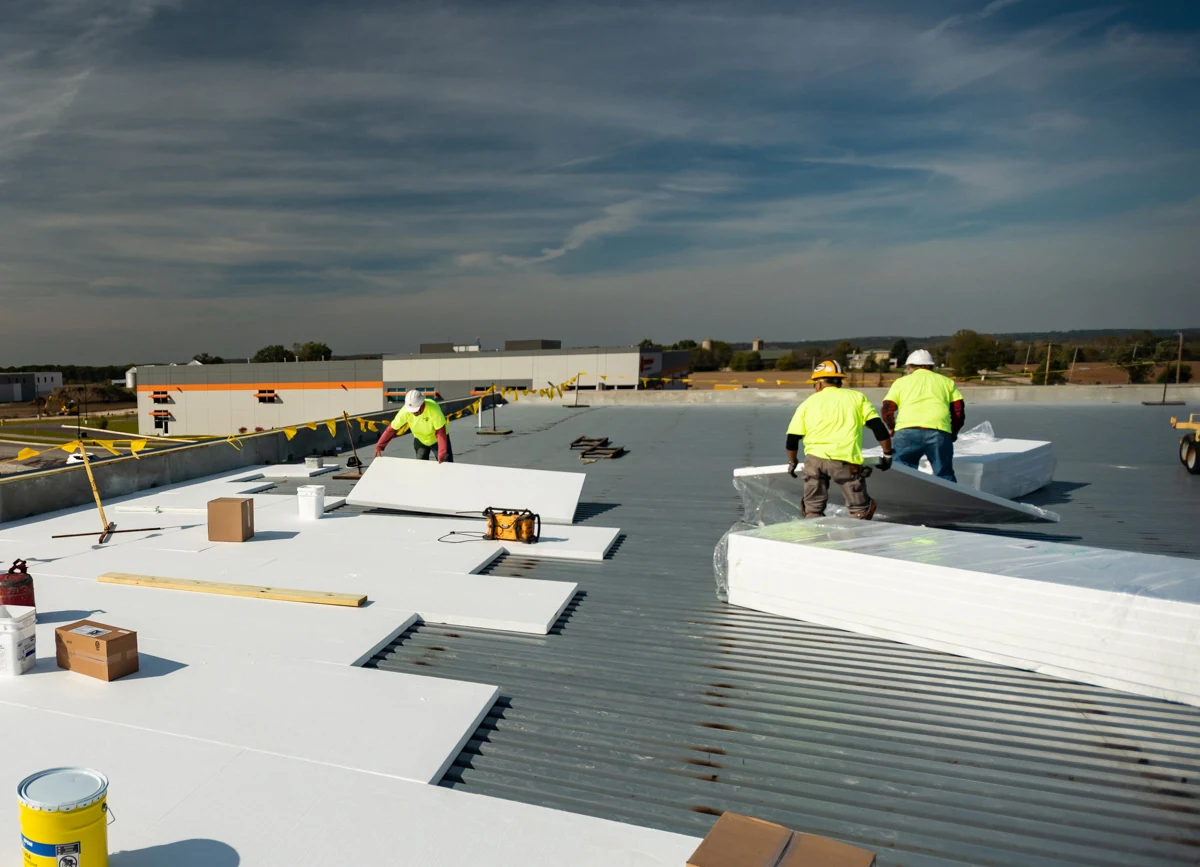
Full Reroofing for Eugene's Low-Slope Commercial Buildings
At some point a roof stops being a repair problem and becomes a replacement decision. We help Eugene property owners find that line before it costs them a tenant, a production shift, or a ceiling full of insulation. Reroofing is a bigger commitment than a patch, so we walk through the numbers and the timeline before anyone signs off.
When Patching Stops Making Sense
A membrane that has taken repeated repairs over several wet seasons starts to show it in ways beyond the obvious leak. Seams open up faster than we can reseal them, insulation underneath stays damp long after a storm passes, and the roof surface develops a soft, spongy feel in low areas that never fully dries between October and May. Once a roof is patched in more than a handful of spots, each additional repair buys less time than the last one did.
We look at the whole system rather than only the spot someone called about. If the membrane is brittle at the seams, if flashing has been re-patched more than once, or if the deck below shows moisture on a core cut, we say so plainly. We are not going to talk a building owner into a full tear-off if a targeted repair or a recover will get another several years out of the roof.
Age alone doesn't answer the question either. We've seen twenty-year-old built-up roofs still performing because they were maintained on schedule, and we've seen a twelve-year-old membrane already past saving because drains went unclogged for a couple of wet seasons in a row. What matters is the condition we actually find during a walk, not the number on the original install date.
Tear-Off vs. Recover on Eugene's Older Buildings
A lot of the commercial stock around Eugene, from older wood-products plant buildings west of downtown to some of the University of Oregon's support structures, has been reroofed once or twice already. That history matters. If the existing membrane and insulation are dry and sound, a recover system can go over the top and save the cost and disruption of a full tear-off. If there is trapped moisture, though, covering it up just seals the problem in.
We cut test sections before recommending either path. Wet insulation gets pulled and replaced regardless of which direction the project goes. Dry insulation stays, and we build the new membrane on top of it. This decision drives the budget more than any other single factor, which is why we do not skip the step.
Scheduling Around the Willamette Valley Wet Season
Eugene gets roughly nine wet months a year, and a reroof needs a dry deck to bond properly. We build the schedule around the forecast, not the calendar, and we plan for a compressed work window during summer and early fall when we can. When a project has to happen during the rainy stretch, we sequence the tear-off in sections small enough to dry in and cover before the next system moves through, rather than opening more roof than we can close in a day.
Documentation We Build Into Every Reroof
Every reroof gets a photo record of the deck condition, the insulation as it comes out, and the new system as it goes down, layer by layer. We register manufacturer warranties at the end of the job and keep copies of the fastening patterns and seam test results. If a property changes hands or an insurer asks about the roof's age and condition down the road, that record answers the question without guesswork.
Materials We Spec for Sustained Rain Exposure
Membrane choice depends on the building's slope, traffic, and rooftop equipment, but on a roof that sees rain nine months of the year, seam integrity matters as much as membrane thickness. We spec systems and attachment methods suited to sustained wet exposure rather than picking based on lowest material cost, and we tie the new membrane into drainage improvements where the old roof was holding water in low spots.
Insulation choice matters just as much as the membrane on top of it. Polyiso holds up well under Eugene's rain load as long as it stays dry during installation, which is another reason we watch the forecast so closely during the tear-off phase. On buildings where the old roof had chronic low spots, we'll often spec tapered insulation as part of the new system so the slope problem gets solved at the same time as the membrane replacement, rather than carried forward into the next roof's lifespan.
- Seams reopening faster than repairs can keep up with them
- Insulation that stays damp for days after a storm
- Soft or spongy deck areas in low-slope sections
- Membrane brittle or cracking at flashing details
- Repeated repairs at the same penetrations or curbs
- Interior staining that reappears after each rain event
Reroofing Questions From Eugene Property Managers
How do I know if I need a recover or a full tear-off?
It comes down to what's under the existing membrane. If a core cut shows dry insulation and a sound deck, a recover is usually the more economical path. If there's trapped moisture, we pull it out rather than build over it.
Can a reroof happen during the rainy season?
Yes, but we section the work so we're never leaving more roof open overnight than we can dry in and protect. Summer and early fall windows are still preferred when the schedule allows it.
Will the new roof come with a manufacturer warranty?
We register systems with the manufacturer at project close and provide the documentation, including fastening and seam test records, so the warranty is enforceable if it's ever needed.
How long does a typical commercial reroof take?
It depends on square footage, deck condition, and weather windows. We give a project-specific timeline once we've seen the roof and cut test sections, rather than quoting a generic number up front.
Do you handle roofs over occupied buildings like hospitals or manufacturing space?
Yes. We sequence and stage work to keep occupied space below dry and operational, which is a routine part of reroofing in a healthcare- and manufacturing-heavy market like this one.