
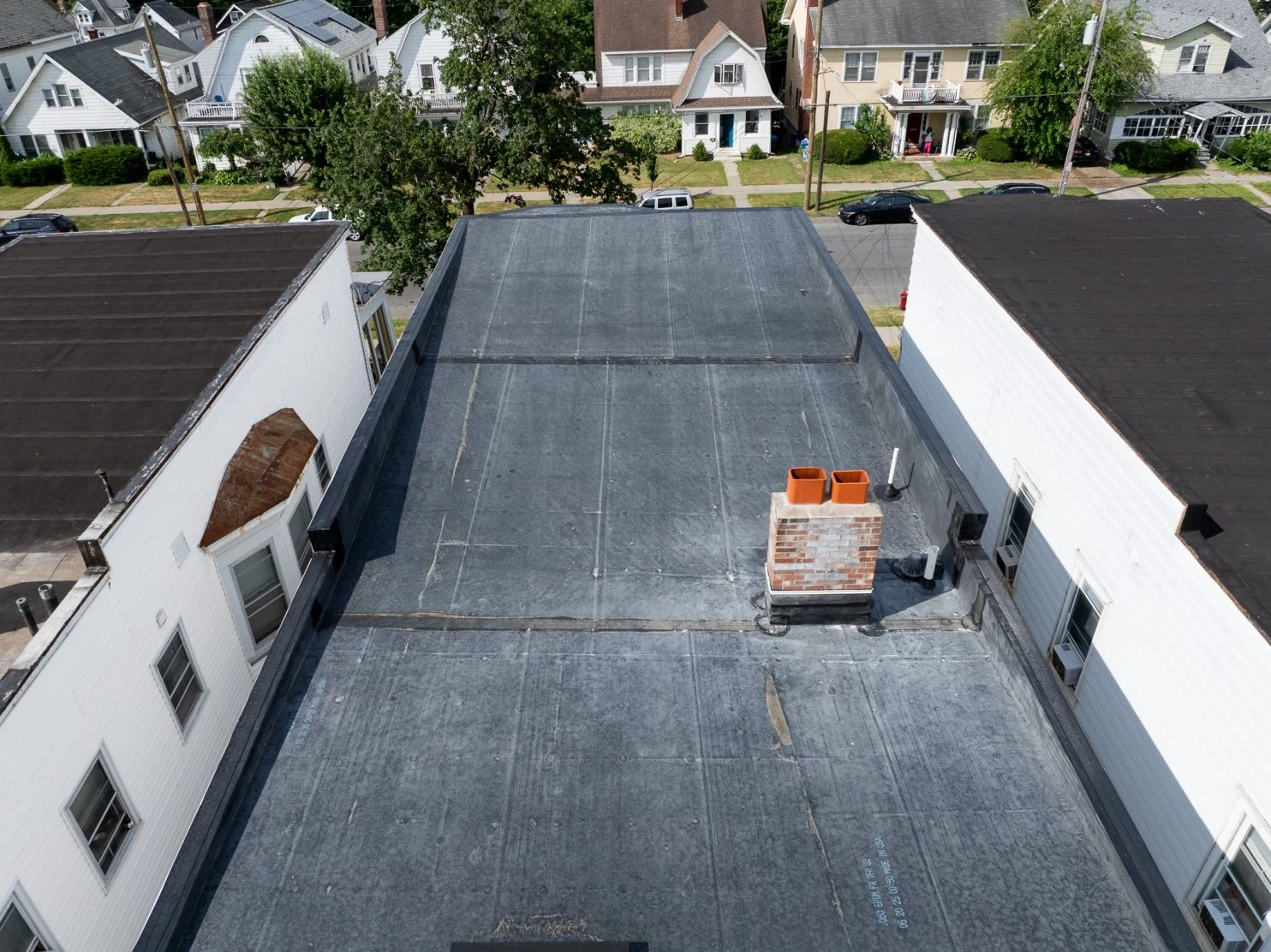
EPDM Rubber Roofing for Eugene's Older Commercial Stock
EPDM has been the low-slope standard for decades, and a lot of the older commercial buildings around Eugene, particularly those near the historic wood-products mill sites along the Willamette, still carry an EPDM roof from a prior renovation cycle. It's a durable, well-understood membrane, but it asks for a different maintenance rhythm than newer heat-welded systems.
Ballasted, Fully Adhered, or Mechanically Fastened
EPDM gets installed three main ways, and the attachment method matters as much as the membrane itself in this climate. Ballasted systems, held down with river rock, are inexpensive and durable but the rock traps needles and leaf litter, which holds moisture against the membrane in patches you can't see without moving stone aside. Fully adhered systems give a cleaner surface to inspect but depend on adhesive bond quality holding up over years of freeze-thaw and saturation cycling. Mechanically fastened systems are more common on lighter steel decks and need periodic fastener checks as the building moves seasonally.
We look at what's already on the roof before recommending a repair strategy, since a ballasted system needs stone pulled back to actually inspect the membrane, which changes how a service visit is scoped.
Seam Tape Is the Weak Point, Not the Membrane
EPDM sheet itself is tough and handles UV and ozone exposure well over a long service life. The failure point on most older EPDM roofs we inspect isn't the field membrane, it's the taped seams, especially on roofs installed before manufacturers improved primer and tape formulations. Seam tape that's fifteen or twenty years old and has spent that whole time cycling wet and dry starts to lift at the edges, and that's where water gets under the membrane.
Because EPDM is black or dark gray, a lifting seam or a moss patch sitting over it is harder to spot on a visual walk than it would be on white TPO. We probe seams directly rather than relying on a surface look, particularly on buildings that haven't had a service visit in a few years.
Where EPDM Still Makes Sense for New Work
For buildings with a straightforward field, minimal penetrations, and a budget that favors installation simplicity over heat-welded detailing, EPDM is still a reasonable choice. Manufacturing buildings tied to the valley's wood-products history often have large open roof fields with relatively few curbs, which suits EPDM's strengths. It also tolerates building movement and thermal cycling well, which matters on older structures with less rigid decking.
Where we steer clients away from EPDM is on roofs with dense penetration clusters or restaurant-adjacent exhaust exposure, where the taped-seam approach and limited chemical resistance become liabilities compared to a heat-welded membrane.
Moss, Algae, and Drainage on Dark Membrane
Moss grows on EPDM the same as any low-slope membrane, and because the surface is dark, growth blends in visually until it's built up enough to be obviously raised. We pay particular attention to low points and areas near roof edges shaded by adjacent trees, which hold moisture longest through the wet season and are where moss establishes first.
Drainage is still the priority item on any EPDM inspection. A ballasted roof with clogged drains can pond water under the stone without any visible surface sign, which is part of why we physically check drain bowls rather than assuming a clear roof surface means clear drainage.
EPDM Service Visit Checklist
- Seam probe testing, prioritizing older tape installations
- Stone displacement check around drains on ballasted systems
- Moss and debris removal from low points and shaded edges
- Flashing check at parapets and mechanical curbs
- Fastener inspection on mechanically attached systems
- Membrane thickness check at high-wear zones near rooftop access
Repair Versus Recover on an Aging EPDM Roof
A lot of the EPDM calls we get are from building owners unsure whether a leak means the whole roof needs replacing. Usually it doesn't. Seam repairs and localized patching handle most active leaks if the field membrane still tests sound. We reserve recover or replacement recommendations for roofs where seam failure is widespread or the deck has taken on moisture from prolonged neglect.
If a recover is warranted, we assess whether the existing EPDM can stay in place as a base layer or needs to come off first, which depends on how much moisture the assembly has already absorbed.
Common EPDM Questions in This Market
Is EPDM still a good option for a new roof, or is TPO always better now?
It depends on the building. EPDM remains solid for large open fields with light penetration counts. TPO's heat-welded seams have an edge on roofs with complex detailing or heavier moisture exposure.
How do I know if my ballasted EPDM roof has a drainage problem?
Interior ceiling staining, especially appearing after a heavy rain event rather than immediately, is often the first sign, since ballasted systems can hide surface ponding under the stone.
Can seam tape be repaired without replacing the whole membrane?
In most cases yes. We strip the failed tape section, clean and prime the seam, and reseal it, which is far less disruptive and costly than a full membrane replacement.
Does moss growth mean the EPDM is deteriorating?
Not directly, but a thick mat holds water against the membrane longer than an open surface would, so we clear it during service visits to reduce that added moisture exposure.
How long does EPDM typically last on buildings in this region?
With regular seam maintenance and clear drainage, EPDM holds up for a long service window here, though the specific lifespan depends on attachment method, installation quality, and how consistently the roof gets serviced.